
The situation
An AI product team was exploring a very large inference and data-processing platform. The early architecture was technically ambitious: regional serving capacity, GPU-heavy inference pools, high-volume media intake, vector search, model release automation, and a control plane for observability and deployment.
The question was not whether the architecture could be drawn. It could. The harder question was whether the organization had a credible path from a large conceptual platform to a system that could be shipped, operated, measured, and corrected when reality pushed back.
This public version is deliberately anonymized and simplified. It removes client names, exact numbers, vendors, topology, commercial detail, and proprietary implementation choices.
Do you actually need this — or will a SaaS LLM API do?
Before any large inference build, the first filter is blunt: most products should stay on a managed model API (OpenAI, Anthropic, Bedrock, Vertex, Azure OpenAI, and similar) until a concrete constraint forces otherwise.
Stay on SaaS when:
- Latency, cost, and rate limits are acceptable for the product shape you have today.
- You do not need model weights, custom training loops, or air-gapped serving.
- Your differentiation is product, data, and workflow — not owning the GPU fleet.
- You cannot yet staff on-call ownership for serving, releases, and cost control.
Build or co-locate custom inference infrastructure when at least one of these is real, not aspirational:
- Unit economics break at projected volume on public APIs.
- Data residency, tenancy, or IP rules forbid sending payloads to a third-party model host.
- You need model versions, routing, and rollback under your own release process.
- You are ingesting proprietary media or documents at a scale where embedding, filtering, and evaluation are part of the product, not a side script.
- Leadership is already funding capacity, and the risk is operating it — not drawing it.
In this engagement, the team was past “should we call an API?” and into “can we operate a platform?” That is a different problem. If you are still on the first question, stop here and size the SaaS path honestly before you fund cells, regions, and GPU pools.
Why the first plan felt risky
Every subsystem sounded plausible on its own. The risk only became visible when they were joined together.
The inference tier assumed strong batching, a predictable model mix, warm capacity, and enough discipline to roll model versions without customer-visible surprises. The intake tier assumed large volumes of media or documents could be filtered, embedded, and converted into product signal without poisoning the release path. The control plane assumed dashboards and deployment automation would be ready before meaningful scale.
Those assumptions were not wrong — they were unpriced. The team had a target-state architecture, but the early roadmap did not separate “can be built someday” from “can be operated by this team next quarter.” That gap was the real engagement.
What we looked at
The review focused on the pressure points that usually decide whether production AI infrastructure becomes an asset or an expensive science project:
- How traffic would move through edge controls, tenant limits, authentication, and model routing.
- How serving would handle batching, cache pressure, cold starts, and versioned deployments.
- How intake would be filtered, embedded, evaluated, and kept out of the release path when quality was uncertain.
- How observability would connect infrastructure signals to product outcomes — not only dashboards.
- How cost, capacity, security, and staffing would be explained to leadership without hiding the operating burden.
A board does not need an inventory of every queue and cache. They need the sequence of risks: which assumptions are proven, which are only modeled, which need procurement or hiring lead time, and which could make the system expensive before it becomes useful.
The public architecture pattern
The anonymized view below keeps the shape of the system without client-specific detail.
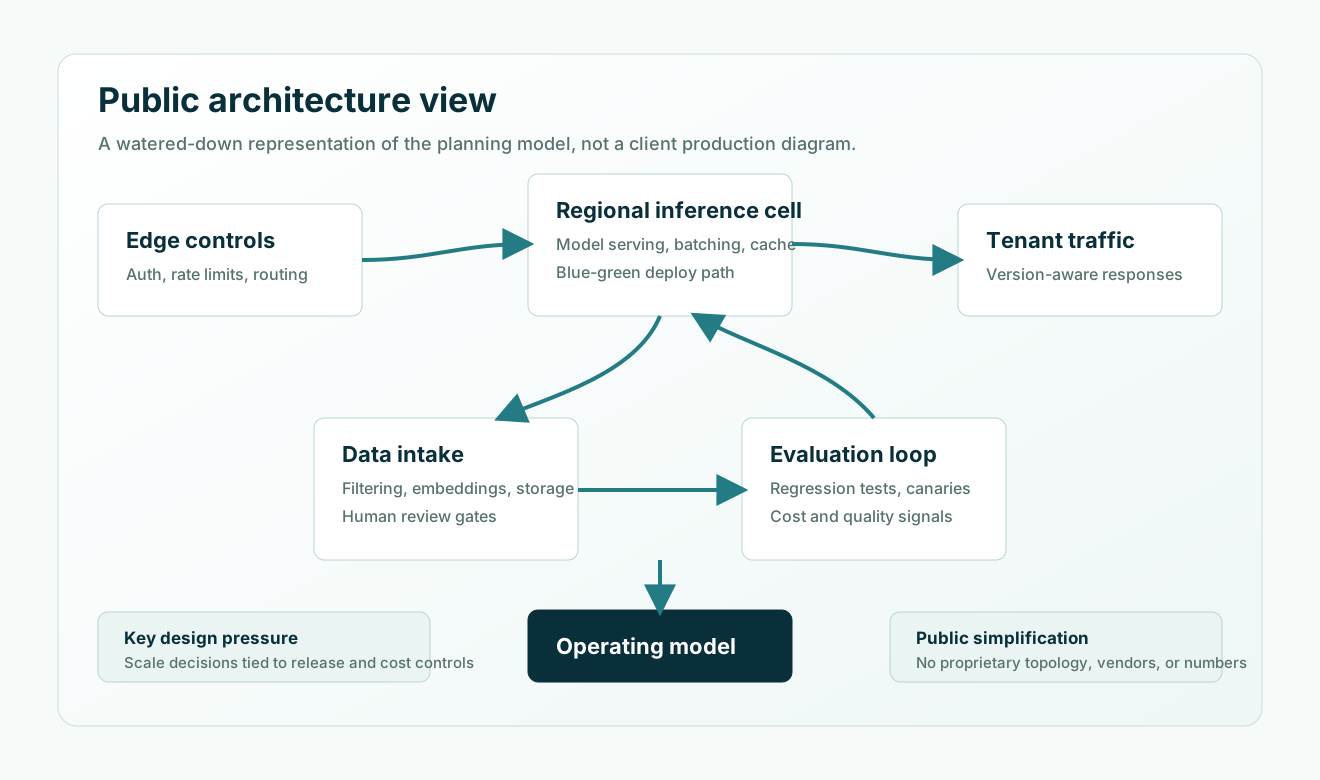
- Requests enter through a policy layer that owns authentication, tenant limits, routing, and safety controls.
- Inference capacity is organized into repeatable cells, not one undifferentiated pool.
- Model release is separated from data intake so fresh content does not automatically become production behavior.
- Evaluation and observability sit on the release path, not off to the side as reporting.
- Cross-region coordination is a reliability decision, not a first-release requirement.
The useful simplification
The strongest intervention was to turn the target platform into staged evidence gates:
- Prove a small inference cell can meet realistic latency, throughput, and rollback requirements.
- Add data intake only after quality gates and human review points are explicit.
- Treat multi-region coordination as a later reliability problem, not a branding claim.
- Put model release automation, evaluation, and incident ownership on the same roadmap as GPU capacity.
That changed the conversation from “how much infrastructure can we buy?” to “which risks must become observable before we scale?”
| Stage | Public description | Evidence required before moving on |
|---|---|---|
| Inference cell | A small, repeatable serving unit with routing, cache policy, deployment, and rollback. | Latency, throughput, utilization, failover, and rollback under realistic load. |
| Controlled intake | A path that can filter, embed, review, and quarantine uncertain material. | Quality gates, human review points, and auditability for what enters downstream systems. |
| Release discipline | Canaries, version headers, evaluation gates, and owner handoff. | Ability to stop, roll back, and explain a model release without heroic coordination. |
| Regional expansion | A second region only after the first cell has stable operations. | Runbook for version consistency, traffic shifting, incident ownership, and customer communication. |
| Executive scaling case | Board-level view of capacity, cost, staffing, and risk. | Decision memo that separates measured facts from assumptions and procurement constraints. |
What changed in the technical plan
The target architecture did not disappear. It became less theatrical and more testable.
Inference moved from a large capacity claim to a repeatable cell: known model mix, routing policy, cache strategy, deployment process, and failure mode. The hard problems — queue pressure, cold starts, context length, cache eviction, batch fragmentation, version drift — show up under load, not on a diagram.
Data intake moved later. Embedding, retrieval, evaluation, and fine-tuning were no longer one automatic conveyor belt. The team needed a way to stop low-confidence data from becoming model behavior: quality gates, sample review, regression datasets, and a release process that could explain why one model version was better than another.
Observability became selective. Instead of collecting everything, the plan asked which signals change a decision: utilization by tenant, time-to-first-token, queue depth, cache hit rate, model version in response metadata, cost per workload, and quality deltas after a model update.
Security moved from “add controls later” to launch criteria. Public APIs, expensive compute, promptable behavior, and automated ingestion create a wide attack surface. Rate limits, input controls, audit logs, secret management, and tenant isolation had to be present before public load.
The risks we reframed
1. Capacity is not throughput
Buying compute is only one part of the problem. Poor batching, uneven tenant demand, long-context requests, cache misses, and cold starts can leave expensive capacity idle or overloaded in the wrong places. Prove a smaller serving unit first — then repeat it.
2. Model releases need product semantics
A model deployment can change customer-visible behavior. The release plan needed version identifiers, canary policy, evaluation gates, rollback thresholds, and a way for support to know what changed. Automation without evaluation is not control.
3. Intake pipelines drift quietly
Parsers change. Feeds shift. Filters become too permissive or too strict. Keep intake out of the critical release path until quarantine, sampling, review, and regression mechanisms exist.
4. Multi-region can create false confidence
Multi-region can improve resilience and also multiply coordination problems: divergent model versions, lagging metadata, failover that reveals hidden routing assumptions. Make one cell boring enough to repeat before you look global.
5. Dashboards are not an operating model
Who gets paged? Which alerts matter? What is the runbook? Which metric tells leadership the system is improving, and which tells engineering to stop a rollout? A useful dashboard is a decision surface, not a wall of charts.
Operating model and takeaways
The revised operating model was practical: product owners justify the next scale step; engineering leaders know which assumptions are measured; infrastructure owns repeatable cells; ML ships through evaluation and rollback gates; security is present before public load; finance sees staged options, not one irreversible bet.
Public takeaways:
- Start with an inference unit small enough to measure and boring enough to repeat.
- Treat model release, evaluation, rollback, and incident ownership as one system.
- Put data intake behind quality gates before it influences production behavior.
- Make multi-region expansion earn its place through reliability evidence.
- Build the executive narrative around decisions, not infrastructure inventory.
What this public version leaves out
The working material included sharper numbers, vendor options, regional assumptions, staffing estimates, and capacity math. Those details stay out on purpose. What remains is the pattern: target architecture versus staged operating proof; failure modes when inference, intake, evaluation, and deployment are coupled too early; and a way for executives to fund the next step without pretending the whole platform is already de-risked.
Outcome
The engagement produced a clearer executive story and a more practical technical roadmap. The client could still pursue the long-term platform, but the near-term plan became smaller, more measurable, and less dependent on heroic assumptions. The most valuable result was not a diagram. It was a shared operating language for what had to be true before the next layer of scale was justified.
If you are facing a similar decision
If you are an infrastructure or platform lead staring at a large AI build — or wondering whether you should be — this is the work we do: turn ambitious architecture into staged proof, operating ownership, and a board-safe funding narrative.
- Architecture / fractional CTO advisory — when the question is readiness, sequencing, and executive technical guidance.
- Production Rescue — when production is already under pressure: cost, reliability, opaque serving, brittle releases.
- Free first consultation — when the shape of the work is still open.
Bring the constraints you already know: volume, latency, data residency, staffing, and what “done” means for the next quarter. We will tell you plainly whether SaaS is enough, whether a custom cell is justified, or whether the plan needs to shrink before it grows.